
What is Mass Timber?
An introduction to CLT and Glulam for UK construction.
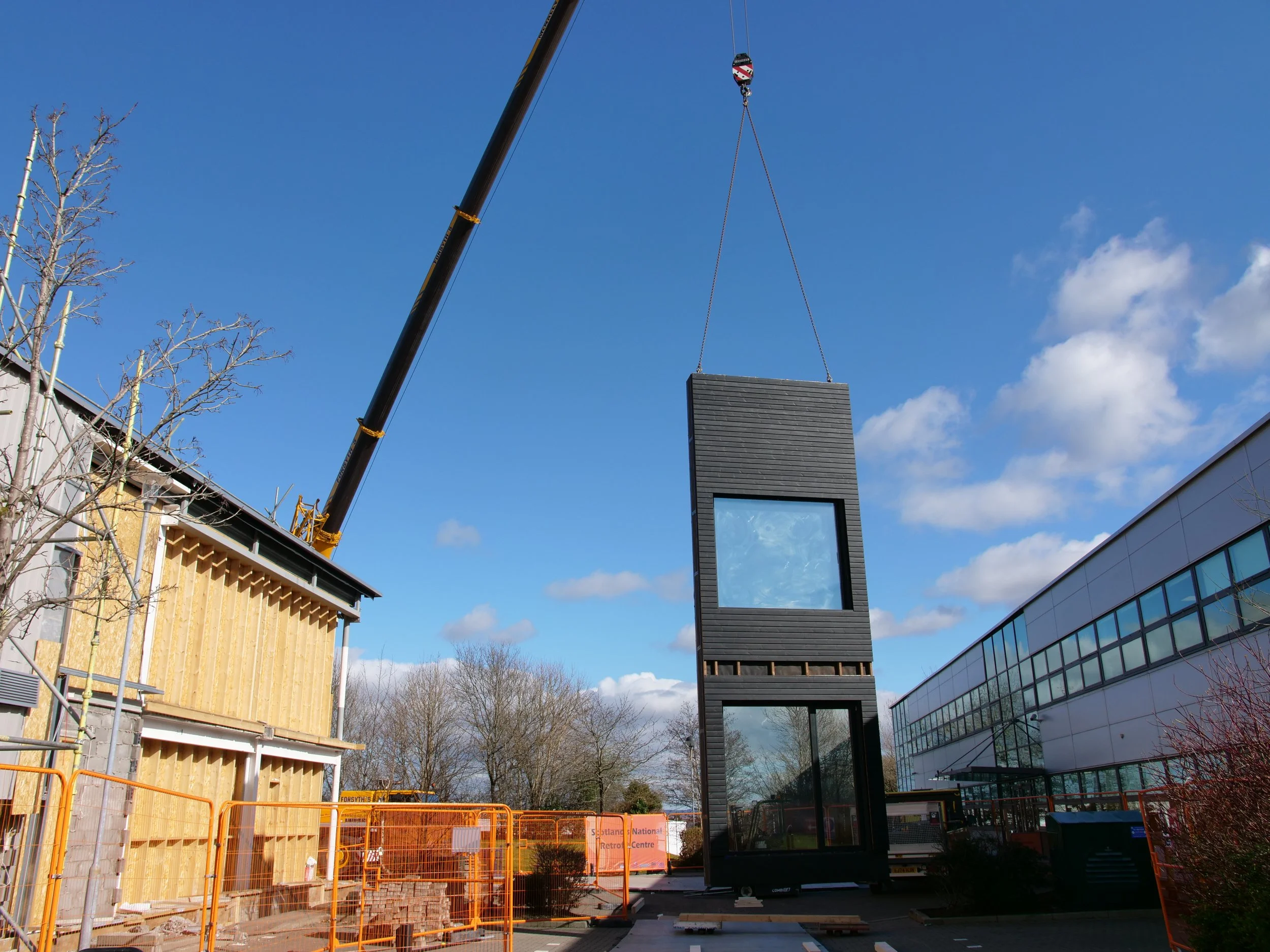
Mass Timber manufactured in the UK utilising homegrown resources offers the construction industry high-performance products with compelling strength-to-weight ratios, build speeds, and sustainability credentials.
Until now, virtually all CLT and Glulam had to be imported from mainland Europe, compounding the UK’s position as the second largest importer of timber products globally. With the launch of the Mass Timber Centre of Excellence, the UK construction industry can now construct buildings truly made, and grown, in the UK, taking advantage of these sustainable products being produced commercially at scale.
What is UK-Grown Mass Timber?
Mass Timber is engineered wood, usually produced as panels or beams, for structural use in the construction of buildings. Popular Mass Timber products include Cross Laminated Timber (CLT), Glued Laminated Timber (GLT or Glulam), Dowel Laminated Timber (DLT), and Laminated Veneer Lumber (LVL).
When correctly grown, harvested, and processed, timber in the UK can meet the structural grading requirements for structural load-bearing construction.
What are CLT and Glulam?
The two most prevalent mass timber products in the UK market, CLT and Glulam, are both manufactured using similar processes, but to serve different purposes.
CLT panels are wood layers glued together at a perpendicular angle, delivering a high-performance, wide and flat panel used for walls, floors, and roofs. Glulam beams are wood layers glued together parallel, creating a long, narrow but high-strength product for beams, columns, and trusses.
The Mass Timber Centre of Excellence has the capacity to manufacture both with precision for a variety of purposes.
Is UK homegrown timber suitable for construction?
There are several myths around the use of homegrown timber, which we have addressed in our article here. One of these is that UK species of wood are not suitable for structural use.
Over 80% of Scotland’s commercial forests are coniferous species. These are primarily Sitka Spruce, which meets the structural grading requirements for CLT and Glulam when suitably processed.
Research by Edinburgh Napier University and BE-ST validated that homegrown timber can be engineered to meet Eurocode 5 structural requirements. The £1.5m Innovate UK-funded “Transforming Timber” project delivered the UK’s first homegrown, two-storey, mass timber home (the COP26 demonstrator), proving the suitability of homegrown timber for construction purposes and the business case for investment in a commercial manufacturing facility.
Benefits of Mass Timber
Building from UK-grown timber has the potential to create higher quality, faster, more sustainable construction at scale. The main drivers for UK grown mass timber construction are speed, performance & strength, sustainability, financial incentives and occupant experience. On a macro-economic level, the benefits around homegrown are localised supply chains, investment in forests, local jobs, reduction of importing risks.
Mass timber construction is faster than traditional methods
The on-site construction period for a mass timber building structure is typically 25-40% less than that of a concrete frame structure – BE-ST experienced these benefits first-hand when retrofitting Scotland’s National Retrofit Centre.
Cost advantages of homegrown mass timber compared to imports
As standard, all timber utilised to manufacture mass timber at the Centre of Excellence is graded at C16. However, European imports tend to utilise C24, which often results in panels and beams being overengineered, potentially resulting in clients overpaying for a product.
Strength and performance
Researchers at Edinburgh Napier University determined that timber grown in Scotland that is strength graded to C16 demonstrates enhanced properties compared to imported C16, specifically, in bending strength and timber density, resulting in the strength class C16+
Environmental benefits
Based on mass timber forms of construction storing 676kg of CO2 per m³, the Mass Timber Centre of Excellence at full capacity would eventually result in over 8million/kg of CO2 being stored annually. For context, this is equivalent to 80,000 car journeys between Glasgow and London or taking 4,700 flights between Glasgow and New York.
Natural resource availability
Timber used at the Centre of Excellence is fully certified, ensuring sustainable forestry practices are adhered to, reducing threats to Scotland’s natural resources.
Scotland’s 1.5 million hectares of trees, woods and forests provide approximately 5.7million cubic metres of coniferous roundwood annually. By 2040, the forecast potential annual availability of coniferous roundwood from our woods and forests in Scotland will be 2 million tonnes greater than now.
Navigating mass timber with BE-ST
Despite significant progress over the last decade, wider mass timber construction adoption remains constrained by cultural, regulatory and market-driven barriers. Correcting inaccurate and outdated perceptions around homegrown timber is needed to drive its greater adoption.
For construction purposes, building regulations and insurance, particularly around the topics of moisture and fire, must be accounted for at an early stage when specifying mass timber.
Working with our expert team and network at BE-ST as an integration partner can help your team overcome the uncertainty or hesitance around mass timber, while reaping the rewards.
Download the virtual tour to see our facility and learn more.