
Masters' fund projects: 24-25
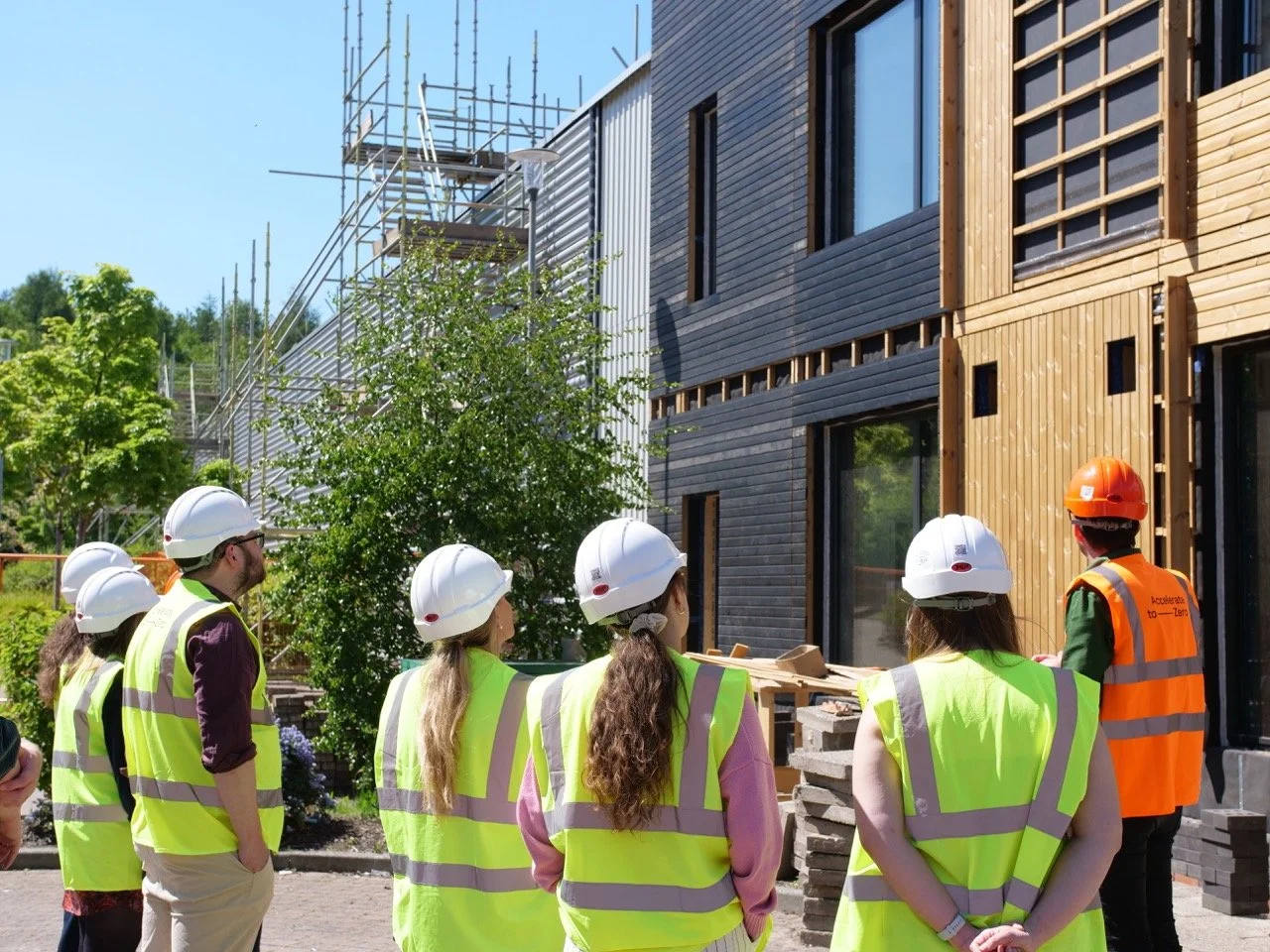
Case studies from the work our students do through the Accelerate to Zero Postgraduate Scholarship.
.
-
Jenny Le Masurier, MDes Interior Design, The Glasgow School of Art
Project
This research project won the Sustainability Prize for its innovative approach to urban design.
It looked at how interior design can turn forgotten urban spaces into calm, healing places that help both nature and people feel better. The project focused on climate change and mental health problems in busy cities. It explored how design can improve outdoor public spaces, not just indoor rooms.
The project used mapping tools to find city 'hotspots' where spaces were too hot and not looked after properly. A street in central Glasgow (Pitt Street) was chosen to study closely. The research created a new type of space called Living Thresholds. These are spaces that respond to weather changes and help people and nature recover.
The project used several methods together: mapping tools, visiting sites, testing materials, and creating design ideas. This helped turn complicated information about temperature and air quality into real design choices that connect with people's feelings. The team tested materials that respond to heat and don't harm the environment, focusing on how they feel, let air through, and can adapt.
Innovation
The research looked at urban spaces in a new way, imagining threshold spaces as creating 'indoor-like moments' within outdoor city areas. By using detailed mapping tools to track heat patterns, green spaces, air quality and temperature, the project found specific places where design could make cities more sustainable. This was a new approach because these environmental tools aren't usually used in interior design.
Benefits
The project helps Scotland's construction industry by showing how design can improve both the environment and people's mental health in cities. For Scotland's older industrial cities, it suggested two connected approaches: adding green spaces that restore nature, and creating spaces that focus on people's needs. These flexible strategies can be replicated in other places. They can guide future city design, construction plans and planning across Scotland, helping cities handle climate change and supporting mental health whilst meeting government goals for sustainable development and public health.
You can find the submission for the prize here.
Partners
The Glasgow School of Art
-
David Gault, MSc Quantity Surveying, Glasgow Caledonian University
Project
This research investigated the wider adoption of Passive House standards within the UK construction industry by evaluating areas for improvement through a direct comparison with BREEAM standards. The study assessed the compatibility of scoring criteria and performance assessment within the context of current building regulations and industry professional opinions. A mixed methods approach was employed, featuring an experimental case study where the Larch House affordable housing project, a known Passive House, was assessed against BREEAM criteria to identify overlaps and strengths. Additionally, an interview questionnaire captured industry views, identifying critical barriers and incentives for using sustainable standards. The findings revealed that while the UK has a strong strategic focus on net zero infrastructure, current building regulations primarily emphasised limited metrics such as U-values and air permeability. The research highlighted a significant need for policy driven encouragement and financial incentives to drive the mainstream adoption of sustainable practices.
Innovation
The primary innovation of this project was the development of a collaborative hybrid framework that synthesised the distinct strengths of both Passive House and BREEAM. While Passive House focused on rigorous building fabric performance and energy efficiency, BREEAM offered a much broader environmental assessment covering land use, ecology, pollution, water, transport, and waste. By integrating these approaches, the researcher created a robust six section framework that utilised Passive House Planning Package (PHPP) calculations as a foundation while applying broader BREEAM environmental targets.
By incorporating the BREEAM credit system, this innovative framework allowed for certification even if certain specific targets were not fully met. This improved accessibility and cost effectiveness for clients and developers, encouraging adoption without compromising building or environmental performance.
Benefits
The research provided a clear justification for using a combined framework to help developers and the government meet 2050 net zero targets. By demonstrating that sustainable construction can be made more financially accessible through hybrid standards, the project offered a practical tool to incentivise adoption. Furthermore, the study recommended that UK policymakers integrate this framework into legislation and provide grants for on site training. This would help upskill the workforce and mitigate the knowledge gaps currently hindering the transition to high performance sustainable building standards across the industry.
Partners
University: Glasgow Caledonian University
-
Blake Smith, MSc Real Estate Management and Investment, Edinburgh Napier University
Project
This research project addressed the gap in how sustainability and energy efficiency are captured within UK residential property valuations. While commercial valuations often reflect the benefits of energy efficient features, the residential sector still relies heavily on the traditional Market Approach, which frequently overlooks the long term financial value of retrofitting. The study utilised a mixed methods approach, combining quantitative surveys with qualitative interviews involving MRICS professionals to evaluate current barriers.
The findings indicated that a lack of comparable market data and standardisation prevented surveyors from accurately reflecting a green premium in property prices. Surveyors expressed concern that current methods were too backwards looking, relying on historical sales rather than future performance. The project concluded that without reform, the residential sector would struggle to reach net zero targets as homeowners lack the valuation incentives necessary to justify significant investment in energy retrofits.
Innovation
The innovation of this project was the proposal of a hybrid valuation model that integrated Discounted Cash Flow (DCF) analysis into traditional residential methods. By incorporating a DCF component, the model allowed for the inclusion of projected energy savings as a tangible financial asset, providing a more forward looking perspective on property value.
The research further proposed a phased implementation strategy for the industry, beginning with the inclusion of non mandatory energy savings projections in Home Reports. This was designed to gradually build market confidence and data, eventually allowing lenders to use this information for preferential green mortgage rates before the model becomes a standard part of surveyor practice.
Benefits
The research provided a framework to increase rational investment in green housing by making the financial benefits of sustainability transparent to buyers, lenders, and surveyors. For the Scottish construction and retrofit market, this model offered a way to unlock demand for energy efficiency improvements by ensuring that such investments were reflected in the final property valuation. By providing clearer information on the "value of green," the project supported a more stable transition to a low carbon housing stock and offered a practical solution to the current stagnation in residential energy retrofitting.
Partners
University: Edinburgh Napier University
Industry Partner: Consulted with several MRICS professionals
-
Euan McIntosh, MSc Spatial Planning with Sustainable Urban Design, University of Dundee
Project
This research project investigated the regeneration of Kirkcaldy town centre, focusing on the potential for increased residential density to combat urban decline. The study addressed the "doughnut effect," where retail migration to out of town locations left historic centres underutilised and deteriorating. By exploring various housing scenarios and repurposing strategies, the research sought to create a more resilient and sustainable urban environment. The project utilised a mixed methods approach, including a comprehensive literature review, policy analysis, and a detailed case study of Kirkcaldy.
Key findings highlighted a critical oversupply of vacant retail space, particularly on the High Street, and suggested that these units were better suited for residential or community use rather than continued retail attempts. The research also identified that successful town centre living required more than just housing; it necessitated the integration of healthcare services, active travel infrastructure, and high quality public green spaces. The findings confirmed that rehabilitating existing historic buildings was more sustainable and cost effective than new builds, while also preserving the unique character of the town.
Innovation
The innovation within this project lay in its design led approach to urban repurposing and the development of site specific housing typologies. Unlike traditional planning studies that focus purely on policy, this research visualised practical scenarios for converting vacant department stores and upper floor retail units into modern, low carbon dwellings.
It proposed a multi faceted governance model, advocating for the creation of a dedicated task force to manage the continued maintenance and rehabilitation of the town centre. This moved beyond the "idealistic" view of regeneration by providing workable solutions evidenced by successful housing association projects elsewhere in Scotland.
Benefits
The project provided a strategic roadmap for Kirkcaldy’s long term recovery, offering evidence based recommendations for local authorities and housing associations. By advocating for the reuse of existing structures, the research supported Scotland’s circular economy and net zero goals through reduced embodied carbon. The proposed scenarios aimed to increase footfall, support social enterprises, and reduce the prevalence of vacant, derelict buildings. Furthermore, the findings emphasised the importance of community led regeneration, ensuring that future developments meet the actual needs of residents rather than just market demands.
Partners
University: University of Dundee (Duncan of Jordanstone College of Art and Design)
-
Alvaro Garcia, Environmental Sustainability, Edinburgh Napier University
Project
This research investigated the behavioural and perceptual factors influencing domestic retrofit decisions among Scottish homeowners. Retrofitting, including measures such as fabric insulation and heat pump installation, is essential for meeting Scotland’s 2045 net zero target; however, annual upgrade rates currently sit below 10,000, significantly short of the 100,000 required annually. The study utilised an online survey to explore public awareness, barriers, and enabling conditions, while critically assessing the Scottish Government’s Heat Transition: Public Engagement Strategic Framework.
The findings revealed that although homeowners held positive views toward sustainability, they often found the retrofitting process technically overwhelming. Cost concerns were identified as the primary obstacle, followed by a significant lack of confidence regarding how to begin or choose appropriate improvements. Crucially, the research discovered that over 50 per cent of participants had never received official guidance. The results suggested that direct benefits, such as financial savings and improved thermal comfort, were far more influential drivers than environmental or climate related messaging.
Innovation
The project was innovative because it shifted focus from purely technical or financial metrics to the underexplored behavioural dimension of the heat transition within a Scottish context. It provided one of the first academic critiques of the 2023 Heat Transition framework. The researcher identified a gap where the strategy’s "Understand, Participate, Act" model failed to provide the practical and emotional support necessary for homeowners to move from awareness to meaningful action. By combining a business management background with environmental sustainability studies, the researcher offered a unique human centred perspective on policy evaluation.
Benefits
The research provided actionable insights for policymakers to design more effective, people centred engagement strategies. By identifying specific demand trends and homeowner expectations, the study helped the Scottish construction market align its services with consumer needs. These findings supported the development of tailored retrofit solutions, potentially boosting market growth and creating skilled employment opportunities. Ultimately, the project advocated for a broader social dimension in public policy to ensure that Scotland’s housing sector meets its climate targets through inclusive, trust based communication.
Partners
University: Edinburgh Napier University
-
Baasit Boluwatife Raji, MSc Civil Engineering, University of Dundee
Project
This research addressed the critical environmental impact of cement production, which currently accounts for approximately 7 to 8 per cent of global carbon dioxide emissions. The project explored the development of low carbon concrete by replacing traditional Portland cement with alternative binders and supplementary cementitious materials (SCMs). The study specifically evaluated the mechanical properties, durability, and life cycle emissions of materials such as limestone calcined clay cement (LC3), alkali activated materials, and various industrial by products to determine their feasibility for large scale application.
A series of rigorous tests were conducted, including compressive strength analysis, water absorption testing, and chloride migration assessments. The findings revealed that calcined clay materials outperformed fly ash in terms of early strength, suggesting that they are a highly viable low carbon replacement for Portland cement in the construction industry. While most fly ash materials exhibited higher water absorption than Portland cement, one specific variant, CDFA4, showed comparable performance. Crucially, the chloride migration tests identified that certain materials, including CFDA1, CDFA2, and CC2F, provided superior resistance to corrosion compared to traditional mixes. This demonstrated that these alternatives are not only more sustainable but also potentially more durable in harsh chloride environments. The research concluded that while there is no single best choice for every application, these materials represent a significant step toward decarbonising infrastructure.
Innovation
The project was innovative in its focus on novel cement formulations, such as geopolymer cements and LC3, which significantly reduced clinker content and associated emissions. It further promoted circular economy principles by maximising the incorporation of industrial waste materials, including slag, fly ash, and construction debris. By moving beyond theoretical study to practical durability testing, the research provided a roadmap for integrating these technologies into large scale construction projects.
Benefits
The study provided measurable benefits for the Scottish built environment by identifying pathways to reduce greenhouse gas emissions and lower the energy intensity of concrete production. It assisted the construction industry in meeting stricter environmental regulations and carbon reduction targets. Additionally, the findings supported the achievement of green building certifications, such as BREEAM, by lowering the embodied carbon of projects. Ultimately, the research provided evidence that sustainable infrastructure can be delivered without compromising structural performance or long term durability.
Partners
University: University of Dundee
-
Dillon Park, MSc Spatial Planning with Sustainable Urban Design, University of Dundee
Project
This research project focused on the application of the 3-30-300 rule, a modern urban planning guideline suggesting that every citizen should see at least three trees from their home, have 30 per cent tree canopy cover in their neighbourhood, and live within 300 metres of a high quality public green space. The study utilised Geographic Information Systems (GIS) to map and quantify compliance with these benchmarks across six distinct neighbourhoods in Dundee. By using the Scottish Index of Multiple Deprivation (SIMD), the project assessed how access to urban greenery varied between areas of high and low socioeconomic status to understand the current state of green equity.
The findings revealed that overall compliance across the neighbourhoods ranged between 65 per cent and 88 per cent. A significant trend emerged showing a moderate positive correlation between wealth and nature; less deprived neighbourhoods generally achieved higher compliance scores for the three visible trees and 30 per cent canopy cover components. However, the results for the 300 metre access component showed an inverse relationship, where more deprived areas often had closer proximity to green spaces. This highlighted a critical need to break down individual components of the guideline rather than treating it as a monolithic target. The project also concluded that the current rule does not account for the qualitative aspects of the green spaces provided.
Innovation
The project represented a significant advancement in urban planning research as it was the first study to assess 3-30-300 compliance in relation to socioeconomic deprivation within a UK context. As the 3-30-300 rule is a relatively new theoretical framework with limited existing literature globally, this research provided essential primary data on its practical application in a Scottish urban environment. Furthermore, the study pioneered an innovative mapping methodology using open source data, which was validated through on site checks to ensure high levels of accuracy. By combining an environmental science background with spatial planning and GIS analysis, the project offered a unique interdisciplinary perspective on how urban design choices can directly impact social justice and environmental resilience.
Benefits
This research established the 3-30-300 rule as a viable and valuable benchmark for future urban greening strategies and new developments throughout Scotland. It provided the construction and planning sectors with evidence based insights into how masterplans can better align with long term sustainability and green justice goals. By identifying disparities in tree visibility and canopy cover, the project supported a more equitable distribution of natural resources, which is essential for improving urban biodiversity, reducing flood risk, and enhancing public health outcomes. The findings encouraged the Scottish construction market to adopt more city specific greening targets that consider spatial equity across different socioeconomic groups. Ultimately, the study contributed to a more socially and environmentally sustainable built environment by highlighting that proximity to green space is only one part of a complex urban ecosystem.
Partners
University: University of Dundee
-
David Gault, MSc Quantity Surveying, Glasgow Caledonian University
Project
This research investigated the wider adoption of Passive House standards within the UK construction industry by evaluating areas for improvement through a direct comparison with BREEAM standards. The study assessed the compatibility of scoring criteria and performance assessment within the context of current building regulations and industry professional opinions. A mixed methods approach was employed, featuring an experimental case study where the Larch House affordable housing project, a known Passive House, was assessed against BREEAM criteria to identify overlaps and strengths. Additionally, an interview questionnaire captured industry views, identifying critical barriers and incentives for using sustainable standards. The findings revealed that while the UK has a strong strategic focus on net zero infrastructure, current building regulations primarily emphasise limited metrics such as U-values and air permeability. The research highlighted a significant need for policy-driven encouragement and financial incentives to drive the mainstream adoption of sustainable practices.
Innovation
The primary innovation of this project was the development of a collaborative hybrid framework that synthesised the distinct strengths of both Passive House and BREEAM. While Passive House focused on rigorous building fabric performance and energy efficiency, BREEAM offered a much broader environmental assessment covering land use, ecology, pollution, water, transport, and waste. By integrating these approaches, the researcher created a robust six section framework that utilised Passive House Planning Package (PHPP) calculations as a foundation while applying broader BREEAM environmental targets.
This innovative model was designed to be more accessible and cost effective than following either standard in isolation, as it allowed for certification even if certain specific targets were not fully met.
Benefits
The research provided a clear justification for using a combined framework to help developers and the government meet 2050 net zero targets. By demonstrating that sustainable construction can be equivalent in cost to traditional methods, the project offered a practical tool to incentivise adoption without compromising performance. Furthermore, the study recommended that UK policymakers integrate this framework into legislation and provide grants for on site training. This would help upskill the workforce and mitigate the knowledge gaps currently hindering the transition to high performance sustainable building standards.
Partners
University: Glasgow Caledonian University
-
Daire Dillon, MSc Quantity Surveying, Glasgow Caledonian University
Project
The project investigated the comparative benefits of bridge refurbishment versus new construction, focusing on cost, sustainability, and cultural importance. Using the Forth bridges and other historical Scottish structures as case studies, the researcher analysed how modern methods of construction could be applied to prolong the lifespan of existing infrastructure. Through in-depth interviews with senior civil engineers, the study captured professional perspectives on lifecycle costs and environmental disturbances. The findings revealed a strong industry preference for refurbishment over replacement, citing lower carbon emissions and the high financial burden of demolition. Notably, the research highlighted how mandatory carbon calculators are now driving procurement, as clients increasingly prioritise contractors with strong sustainability credentials. Experts also noted that while off-site prefabrication is growing, Building Information Modelling (BIM) remains underutilised in the bridge sector compared to other construction areas.
Innovation
Innovation was central to the study's exploration of modern maintenance techniques, specifically the flex-beam scaffold system designed for easier access to bridge undersides. The research also broke new ground by attempting to quantify the cultural and heritage value of Scottish bridges in monetary terms, moving beyond traditional usage and income metrics. Furthermore, it evaluated the potential of traditional stone arch bridge designs as a long-term, low-maintenance alternative for smaller crossings. The study advocated for a shift toward preventative maintenance strategies, supported by structural health monitoring technologies that enable early detection of issues and scheduled interventions rather than reactive emergency repairs.
Benefits
The findings provided a clear case for preserving Scotland’s architectural heritage, including UNESCO World Heritage sites. By demonstrating that restoration is often more viable than replacement, the project helped reduce the construction sector's carbon footprint and delayed the need for carbon-intensive new builds. The research also highlighted that greater integration of BIM could support more efficient asset management and collaboration across the industry. Ultimately, the project offered a framework for more sustainable infrastructure planning that balances economic, social, and environmental goals while preserving local character.
Partners
University: Glasgow Caledonian University
Industry Partner: Transport Scotland / Bear
-
Dan McIntosh, MSc Spatial Planning with Sustainable Urban Design, University of Dundee
Project
This research explored how Scotland can deliver circular, inclusive, and resilient neighbourhoods as part of its transition to net zero. The study utilised Edinburgh’s Seafield regeneration as a primary case study and conducted a comparative analysis with international examples in Malmö and Freiburg to identify transferable lessons for infrastructure and participation. Through a structured policy review and spatial analysis, the project evaluated five key Scottish planning documents, finding a significant fragmentation between national ambitions and local delivery. The findings highlighted that while policy rhetoric around circularity and justice was strong, these principles were often underdeveloped as practical mechanisms in live masterplans. Specifically, the Seafield case study revealed weaknesses in material reuse, affordable housing provision, and participatory governance. The project concluded that circularity is currently framed as a superficial efficiency measure rather than the systemic change required for genuine sustainability.
Innovation
The innovation of this project lay in its development of a design-led framework that translated high-level circular economy and just transition principles into actionable, neighbourhood-scale strategies. It critically assessed how existing planning tools, such as National Planning Framework 4 (NPF4) and the Circular Economy Route Map, either enabled or constrained sustainable development. By synthesising international best practices with local policy, the project created a speculative but transferable framework structured around five interconnected systems: circular infrastructure, participatory governance, equity-embedded housing, resilient public realms, and integrated mobility. This approach moved beyond viewing circularity as simple recycling, framing it instead as a systemic requirement for urban regeneration that must be structurally embedded in the planning process.
Benefits
The project provided a transferable framework for embedding circularity and justice into future Scottish regeneration projects. It offered practical guidance for developing affordable, low-carbon housing and infrastructure, helping to close the gap between national policy and spatial delivery. Furthermore, the research contributed valuable insights to the wider construction market regarding circular design, participatory governance, and climate adaptation. The final recommendations called for statutory design guidance on material reuse and the integration of distributive justice into housing provision, supporting Scotland’s ambitions for a just transition and long-term community resilience.
Partners
University: University of Dundee (Duncan of Jordanstone College of Art and Design)
-
Eloise Griffin, MSc Spatial Planning with Sustainable Urban Design, University of Dundee
Project
This research examined the 20-minute neighbourhood (20MN) concept, an urban planning approach designed to ensure daily needs are met within a short walk or cycle from home. The study investigated the historical evolution of the model, tracing its roots from Ebenezer Howard’s Garden City to contemporary 15-minute city initiatives. By evaluating how retheorised planning principles shaped 21st-century application, the project addressed challenges such as climate change and social inequality.
Key findings revealed that while sustainability and resilience were strongly embedded in policy language, equity was frequently treated as an aspirational ideal rather than a binding requirement. The research concluded that without enforceable mechanisms for inclusion, the model risked reproducing spatial inequalities and contributing to gentrification or displacement.
Innovation
The innovation within this project lay in combining historicity with critical discourse analysis to examine both the conceptual evolution and contemporary policy framing of the 20MN. Unlike existing research that focused primarily on technical delivery or environmental benefits, this study situated the model within a historical lineage to expose underlying ideological assumptions. By bridging academic theory with professional experience gained within a local authority planning service, the research offered a nuanced, context-sensitive understanding of how inherited planning concepts are reassembled to meet current policy agendas.
Benefits
The project provided planners and policymakers with deeper insights into adapting 20MN principles to Scottish contexts in ways that prioritised equity. It generated specific recommendations to avoid policy blind spots, such as unintended social and spatial inequalities. For the wider Scottish construction market, the findings informed place-based investment decisions and encouraged integrated planning across housing, transport, and infrastructure. The research delivered a conceptual framework for justice-oriented planning, advocating for transparent monitoring and community ownership to ensure the creation of genuinely inclusive, low-carbon communities.
Partners
University: University of Dundee (Duncan of Jordanstone College of Art and Design)
-
Rowan Matthew Ilett, MSc Quantity Surveying, Glasgow Caledonian University
Project
This research investigated the decarbonisation of the UK rail network, which must be achieved by 2045 in Scotland and 2050 across the rest of the UK. The study focused on overcoming the substantial cost barriers that have historically hindered electrification projects when using traditional methods. The researcher identified unique challenges within the UK context, such as limited grid capacity, high land values, and a lack of consistent political direction. The project evaluated how two specific pieces of energy distribution equipment could be utilised to bypass these obstacles. By engaging with electronic engineers and industry experts, the research assessed the viability of integrating these technologies into both new-build and retrofitting projects to ensure they become more commercially attractive.
Innovation
The innovation within this project lay in the detailed analysis of improved energy distribution technologies and their direct impact on project logistics. The research focused on Rail Charging Converters (RCC), which can draw power from non-traditional sources and are capable of charging battery-powered trains.
Furthermore, the study examined Sicat SX, an advanced overhead transmission line system. Unlike conventional lines, Sicat SX utilised increased wire tension to reduce the overall requirement for heavy civil engineering and electrification equipment. This technical shift allowed for a reduced project scope, demonstrating how modern equipment can solve traditional infrastructure design problems.
Benefits
The research proved that the application of these technologies would significantly improve the business case for new electrification projects by delivering massive cost reductions. These findings suggested that decarbonising the railways could be achieved much more cheaply than previously estimated, making it more likely that future projects will be commissioned. Beyond technical savings, the project highlighted critical systemic findings; it concluded that inconsistent funding has historically led to a loss of expertise within the industry. The study suggested that the transition to Great British Railways might enable a more cohesive "track and train" strategy. Ultimately, the project provided a clear pathway for the Scottish and British rail sectors to reach net-zero targets through sustainable, cost-effective innovation.
Partners
University: Glasgow Caledonian University
Industry Partner: Siemens Mobility provided essential technical expertise, information on global cost challenges, and mentorship from electronic engineers to support the quantity surveying perspective of the research.
-
Darren O’Hare, MSc Quantity Surveying, Glasgow Caledonian University
Project
The research investigated the environmental performance of Modern Methods of Construction (MMC) and Off-Site Manufacturing (OSM) in comparison to traditional building techniques. A mixed-methods approach was utilised, combining quantitative survey data from the general public and industry professionals with qualitative insights from interviews with construction experts. The study focused specifically on the UK and Scottish construction sectors to assess how these innovative methods met sustainability goals. Key findings confirmed that MMC and OSM delivered measurable environmental advantages, including significant reductions in embodied carbon, construction waste diversion from landfills, and lower on-site energy use. Statistical analysis, including t-tests, ANOVA, and Chi-squared tests, was applied to rigorously evaluate these environmental and perception-related outcomes.
Innovation
This project was unique in its research design because it combined the views of both the general public and industry professionals. This dual perspective provided a more comprehensive understanding of the barriers to adoption than studies focusing solely on practitioners. By interviewing professionals actively involved in live MMC projects, the research captured first-hand, evidence-based case studies that moved beyond theoretical assumptions. The study shifted the primary focus from typical cost-based metrics to specific environmental outcomes and public willingness to adopt modern building practices. It directly supported the Accelerate to Zero objectives by identifying practical steps for increasing adoption through policy, education, and procurement recommendations.
Benefits
The research provided several advantages for the wider Scottish construction market. It offered quantifiable evidence of environmental benefits, supporting Scotland’s transition to net zero and aligning with sustainable transformation goals. The study identified primary barriers to wider adoption, such as a lack of sector-specific education and entrenched cultural resistance, and proposed actionable solutions for future procurement strategies. Furthermore, the findings revealed that while the public was increasingly open to MMC environments, significant concerns regarding safety and durability persisted due to a lack of awareness. Practical recommendations included expanding MMC training across the sector and implementing targeted awareness campaigns to build trust and demand.
Partners
University: Glasgow Caledonian University
Industry Partner: Scotwood, based in East Kilbride, provided direct access to professionals, survey distribution networks, and real-world project case studies
-
Blair Cooney, MSc Construction Project Management, Edinburgh Napier University
Project Innovation
This research reframed workforce mental health as a critical driver of construction project performance and social sustainability, rather than solely a welfare concern. While mental health in construction has been studied previously, this project went further by directly linking mental health to measurable project outcomes including productivity, safety, workforce retention, and delivery timelines. Using a mixed-methods approach, the study combined survey data from 70 professionals with six semi-structured interviews across site-based and managerial roles, providing a practice-focused understanding typically absent from industry reports. By identifying cultural, organisational, and operational barriers to effective support, the research offered evidence-based recommendations that could be embedded into project delivery frameworks.
Benefits
The research provided deeper understanding of how poor mental health affects key construction outcomes. Over 85% of participants had experienced mental health challenges during their careers, with clear links to decreased productivity (83%), increased safety risks (86%), and project delivery challenges (71%). The study identified common workplace stressors and barriers limiting effective support, including stigma, fear of judgement, and lack of trust, with almost half of respondents never having accessed formal wellbeing resources.
For the wider Scottish construction market, the findings support a stronger, more sustainable industry by positioning mental health as essential to social sustainability. Addressing workforce wellbeing strategically can help tackle skills shortages, improve retention in a competitive labour market, and enhance the industry's reputation as an employer of choice. The research demonstrated that improved mental health provision reduces absenteeism, lowers turnover costs, minimises productivity losses, and supports safer site operations.
Key outputs included evidence-based recommendations for integrating wellbeing into project delivery frameworks through targeted leadership training and proactive communication strategies, plus a framework identifying barriers to effective mental health support that organisations can use to benchmark and improve their practices.
Partners
University: Edinburgh Napier University, School of Computing, Engineering, and the Built Environment
Industry Engagement: Multiple contractors including Balfour Beatty, Story, Taziker, and City Access Scaffolding provided access to participants and expressed keen interest in applying the findings to improve site-level worker wellbeing.
-
Nathan Reid, Environmental Sustainability, Edinburgh Napier University
Project
This project evaluated the effectiveness of existing flood defences along the Water of Leith, running from Balerno to The Shore in Leith. The research formed part of the Accelerate to Zero Scholarship Programme and focused on assessing whether current flood defence measures were sufficient to withstand a 1 in 100-year flood event, comparable to the major flood experienced on 26 April 2000. Primary data was collected through detailed visual inspections of flood defence structures along the Water of Leith walkway. Each defence location was geo-tagged to support spatial analysis and modelling. Using this data, a flood event model was developed to simulate flood extents and impacts along the river corridor. The modelled results were then compared with SEPA’s existing flood vulnerability maps to assess alignment and identify any discrepancies.
Innovation
The research moved beyond reliance on existing flood risk mapping by testing how flood defences performed in practice rather than in theory. While SEPA provides national flood risk maps for properties, this research directly evaluated the condition, placement and effectiveness of physical defences currently in place. By combining on-site inspections with flood modelling, the study provided a more granular understanding of flood vulnerability along the Water of Leith and offered a practical assessment of whether mapped risk reflected real-world conditions.
Benefits
The dissertation provided valuable insights into the adequacy of current flood defence measures along one of Edinburgh’s key urban waterways. Findings highlighted areas where defences appeared robust, as well as sections where land and infrastructure remained vulnerable during extreme flood events. The research also identified opportunities to reduce flood risk through alternative approaches, including natural flood management techniques. These insights were relevant to local authorities, environmental bodies and the wider Scottish construction and infrastructure sector, particularly in the context of climate resilience and adaptation.
Partners
University: Edinburgh Napier University
-
Steven Rennie, MSc Spatial Planning with Sustainable Urban Design, University of Dundee
Project
This study positioned urban design and spatial planning as strategic tools to interrupt widening disparities and advance spatial justice throughout Scotland's net-zero transition. Addressing a significant gap in existing transition literature, which predominantly centres on national energy and labour policies, the research drew attention to the comparatively underexplored role of urban design in shaping debates around an equitable transition at the city level.
The study employed a tripartite justice framework, in which distributive justice referred to the equitable allocation of resources, procedural justice to inclusive governance, and spatial justice to territorial equity. Through a comparative case study of Edinburgh, Glasgow and Dundee, and conducting thematic analysis of planning documents using NVivo, the research determined that policy lexicon was often detached from enforcement.
Findings revealed a persistent disconnect between policy rhetoric and spatial outcomes. Green investments clustered in affluent urban cores, bypassing deprived peripheries, whilst procedural justice remained tokenistic, with community consultation on net-zero rarely translating to decision-making power. Skills-geography mismatches excluded marginalised communities from green economy hubs. Although urban policy was often presented as environmentally progressive and socially equitable, delivering truly just outcomes remained a complex and ongoing challenge.
Innovation
The research innovatively applied NVivo to draw out spatial equity queries within current Scottish planning policies, developing and applying a novel tripartite justice framework to assess institutional barriers and enablers. This methodological approach provided a systematic means of evaluating how distributive, procedural and spatial justice dimensions interacted within net-zero planning, revealing patterns of investment clustering and governance deficits that conventional policy analysis might overlook. The framework offered a replicable analytical tool for critically assessing the equity implications of climate transition strategies across different urban contexts.
Benefits
The study offered significant benefits to the Scottish construction and planning sectors by proposing three transformative pathways: spatial covenants requiring at least 30% of green investment to be directed toward deprived areas through Section 75 agreements; statutory co-governance institutions including Climate Assemblies with budget amendment powers; and mandatory Equity and Spatial Justice Assessments functioning similarly to Environmental Impact Assessments. These recommendations directly support equitable training within green sectors, co-locating vocational training hubs within transition zones and aligning retrofit projects with green skills curricula. By identifying best practices and ongoing challenges in embedding just transition principles, the research provides actionable guidance for ensuring Scotland's net-zero strategy delivers a genuinely fairer, greener future.
Partners
University of Dundee
-
Eloise Griffin, MSc Spatial Planning with Sustainable Urban Design, University of Dundee
Project
This dissertation examined how the 20-minute neighbourhood (20MN) has emerged as a prominent urban planning model, promoted for its potential to create sustainable, inclusive and resilient communities. The research traced the concept's lineage through historical neighbourhood planning models including the Garden City, Neighbourhood Unit and New Urbanism, exploring how these earlier approaches sought to integrate proximity, functionality and community cohesion but frequently failed to address structural inequalities and questions of justice.
Using a historically informed qualitative approach grounded in the concept of historicity, the study employed critical discourse analysis to examine planning frameworks and policy documents from diverse contexts. The analysis interrogated how equity, sustainability and resilience were defined, prioritised and operationalised, and how these principles influenced implementation strategies. The research drew on sources including Scotland's National Planning Framework 4, Plan Melbourne and Paris' 15-Minute City, alongside historical planning texts and academic literature.
The findings indicated that whilst the 20MN offers a persuasive vision for more connected and liveable communities, its implementation can risk entrenching spatial and social inequalities. Equity was often treated as an aspirational ideal rather than a binding policy requirement, sustainability was framed predominantly in environmental terms with less emphasis on social and economic dimensions, and resilience was frequently approached as a technical capacity for adaptation with limited attention to political and structural factors determining who benefits from adaptive measures.
Innovation
The research innovatively situated the 20MN within its broader temporal and spatial lineage, demonstrating it is less a new invention than a contemporary rearticulation of enduring planning logics. By applying critical discourse analysis to trace how equity, sustainability and resilience have been retheorised over time, the study revealed how these principles, though frequently cited in policy rhetoric, remain unevenly integrated and often reduced to managerial objectives. This historically grounded approach exposed tensions between the 20MN's inherited spatial ideals and contemporary claims of inclusivity, challenging assumptions that proximity alone delivers justice.
Benefits
The research offers practical benefits for policymakers and planners by providing clear operational definitions, balanced emphasis on environmental, social and economic goals, and mechanisms to ensure accountability in implementation. By demonstrating how the 20MN must embed equity, sustainability and resilience as substantive social objectives rather than depoliticised technical targets, the study contributes to debates on advancing more just, inclusive and resilient cities. The findings support integrated governance, enforceable policy mechanisms and participatory processes that prioritise marginalised communities, offering a replicable critical framework for evaluating and improving contemporary neighbourhood planning approaches across Scotland and beyond.
Partners
University of Dundee
-
Nathan Gemmill, MSc International Construction Project Management, Glasgow Caledonian University
Project
This research investigated the critical role of client-side project management consultancies in translating high-level net zero commitments into tangible construction outcomes. While the UK has set ambitious 2050 climate targets, a gap remains between strategic intent and project-level delivery. The study employed a qualitative approach, conducting six semi-structured interviews with industry professionals across various seniority levels to explore how sustainability mandates were embedded in project lifecycles.
The findings revealed significant inconsistencies in how net zero strategies were operationalised. Primary barriers included fragmented understanding of sustainability goals, the delayed integration of carbon priorities into the design process, and frequent cost-driven compromises. The research concluded that while consultancies possessed the technical potential to influence outcomes, they were often constrained by traditional procurement models and a lack of clear governance, which hindered the consistent delivery of low-carbon infrastructure.
Innovation
The innovation of this project lay in its focus on the "middle-management" role of consultancies as the primary drivers of cultural and systemic change. Rather than focusing solely on technical solutions, the research proposed a new delivery framework that prioritised carbon literacy and early-stage influence.
A key recommendation from the study was the redefinition of "value" within consultancy practice. The researcher proposed moving away from the traditional "iron triangle" of cost, time, and quality towards a model that weighted long-term carbon performance as a primary metric. This included the implementation of "carbon-hold points" at critical project stages to ensure sustainability goals were not value-engineered out of the final build.
Benefits
The research provided actionable pathways for the UK and Scottish construction sectors to close the gap between national policy and project reality. By identifying where current frameworks fell short, the study offered a roadmap for consultancies to act as catalysts for decarbonisation through better client education and strengthened internal governance. The findings supported the industry in moving towards a more accountable and consistent method of delivery, ensuring that net zero goals were treated as non-negotiable contractual requirements rather than optional extras.
Partners
University: Glasgow Caledonian University
Industry Partner: Craig Thompson (Academic/Industry Specialist)