
INT011 - Design for Manufacture and Assembly (DfMA) for Offsite Timber Construction
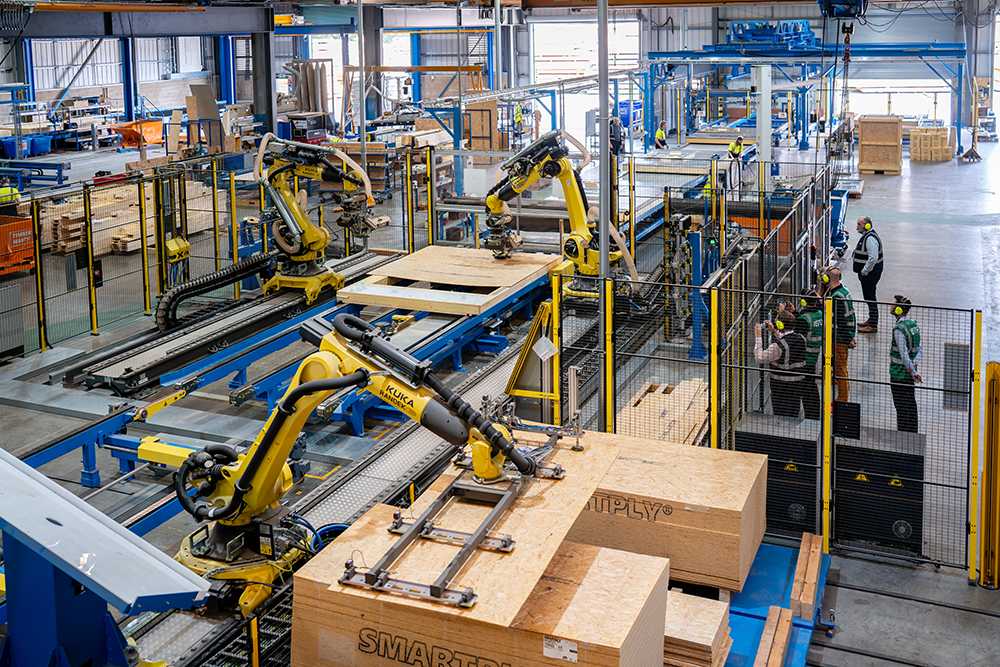
This learning scenario introduces learners to the principles of Design for Manufacture and Assembly (DfMA) within offsite timber construction. The intervention focuses on developing awareness of how design decisions influence manufacturability, logistics, transport, installation sequencing, and onsite coordination.
Upon completion of this course, learners will be able to:
Explain the principles of industrialised timber construction and how DfMA influences design, manufacture, and installation.
Critique design decisions in relation to manufacturability, standardisation, tolerances, and factory production flow.
Identify logistical constraints affecting offsite timber systems, including transport, site access, crane strategy, and installation sequencing.
Describe how early stage design choices impact onsite assembly efficiency, safety, and coordination.
Apply design thinking methods to evaluate a project scenario and propose improvements for manufacture, logistics, and installation.
Communicate effectively within multidisciplinary teams (design, factory, installation) to resolve DfMA related challenges.
The scenario is designed for entry-level learners, apprentices, site based contractors transitioning to timber frame, and individuals progressing into offsite construction roles. Delivery adopts a blended learning approach combining classroom teaching, guided discussion, visual learning materials, and scenario based group activities.
Learners engage with real world examples, factory imagery, transport constraints, installation planning diagrams, and project scenarios to reinforce understanding of DfMA and offsite construction workflows.
The learning experience emphasises communication, coordination, systems thinking, and understanding of how design choices cascade through manufacturing and onsite assembly. Learners are encouraged to reflect on how planning, standardisation, tolerances, logistics, and human behaviour influence safe and efficient offsite timber construction.
The EDIP (Explanation, Demonstration, Imitation, Practice) model is used throughout, supported by AAR (After Action Review) reflection sessions.
Intervention at a Glance
TiC Competency: Skills Action Plan
Primary: Design & Specification | Manufacture | Construction
Secondary: Core Behaviours and Meta Skills (Collaboration and Teamwork, Problem Solving, Communication) | Cross Disciplinary Competencies (Quality, Systems Thinking, Logistics Awareness
Target Audience:
Operatives & Skilled Trades
Technical Staff & Site Supervisors
Design Professionals & Project Managers
Specialist Engineers & Strategic Leaders
College & University Students
Target Education Level: RQF/NVQ/SVQ 2-3 | FHEQ 4 | SCQF 5-7
Indicative Learning Hours: 7 hours
Teaching materials prepared for this Learning scenario include:
INT11_Presentation (Sessions 01-06)
INT11_Workshop_Scenario Pack
INT11_ Knowledge Check Questions
Additional resources recommended for this Learning Scenario include:
TDUK – Knowledge Library – Timber Panels
TDUK – Knowledge Library – Timber Connection Design
IStructE Timber Engineering Notebook Series – No.3 Timber Frame Structures
Supply Chain Sustainability School – DfMA Module
Offsite & Industrialised Timber Construction (Hairstans, 2019) – Chapters 2, 3, 4