
Social Bite and Ecosystems Technologies on tackling homelessness through timber
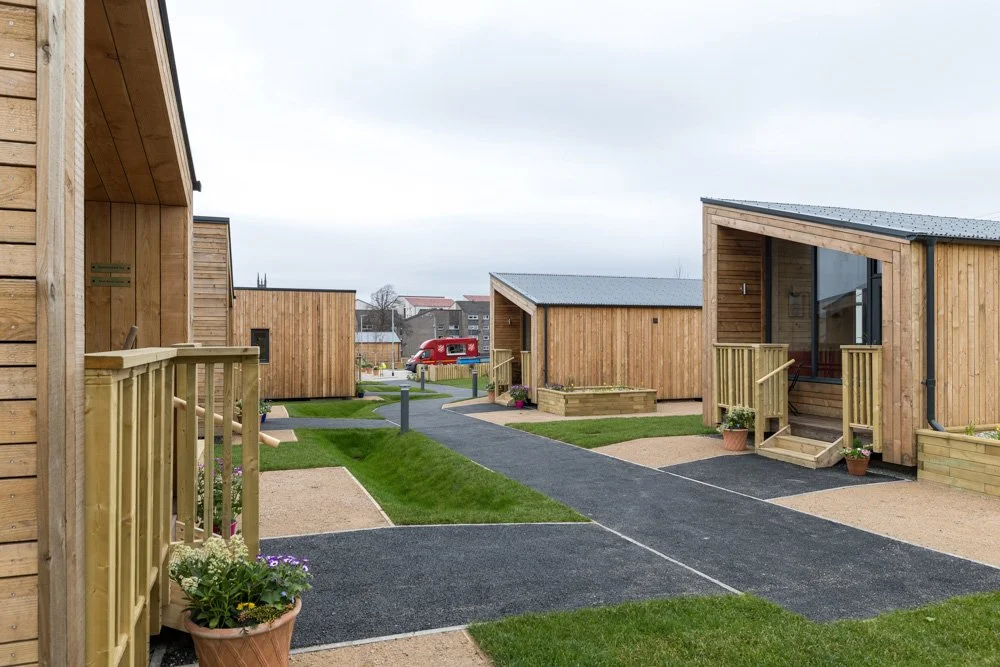
What happens when a homelessness charity partners with a mass timber manufacturer? Elaine Mullan, Trust and Foundations Manager at Social Bite, and Matt Stevenson, founder of Ecosystems Technologies, explain how the Social Bite Villages are changing lives and what it takes to build them.
Elaine, what is a Social Bite Village?
It’s s temporary accommodation, but not as anyone expects it. People can stay as long as they need, until they find a permanent home. We built the first one in Granton, Edinburgh, in response to the temporary accommodation crisis in 2017, when what was on offer was substandard, expensive and simply not working.
Every village pairs safe, beautiful homes with on site support. This combination is what makes the Social Bite model so transformative.
And the newest one, at Harriet Gardens in Rutherglen?
Fifteen one-bedroom nest houses and a community hub, built with South Lanarkshire Council. They helped us find the land, supported the costs, and linked us into their housing and homelessness services, which matters because they are the ones that know the area well and its needs. All fifteen homes are already full. The Salvation Army delivery on site support to residents. Within weeks of it opening, we’ve seen a genuine community form.
Matt, why timber and why homegrown?
We wanted to solve a supply problem. There was no source of homegrown cross laminated timber or glulam. The majority of timber was being imported from Europe. Working with BE-ST and Edinburgh Napier University, we proved we could commercialise Scottish homegrown timber.
Timber is unique as a renewable building material. By using responsibly sourced timber, we can support the growth of new forests while locking carbon into the fabric of our buildings. This not only reduced the carbon footprint of construction but also has the potential to deliver a positive environmental impact.
How did modular construction shape the design?
The nest house shell is based on a design we’d already delivered for high-quality leisure accommodation, because people rebuilding their lives deserve an aspirational home, not a stopgap. Modular meant we could move fast, which mattered given the urgency, and it meant the homes could be relocated when a site’s use changed. Granton sat on land always earmarked for redevelopment. After eight years and more than 100 residents housed, the time came to move, and because the construction uses light-touch jack-pad foundations, we simply could.
What proved the timber could take that kind of use?
A prototype nest home lived at the BE-ST’s Mass Timber Centre of Excellence in Blantyre, travelling to events at Gleneagles and Dundee along the way. It’s moved seven or eight times with no loss of quality, and the exposed cross laminated timber does double duty – full structural strength with a warm, finished interior.
Fifty years from now, what does success look like?
Elaine: That Scotland and the UK no longer have a homelessness problem. Even then, people will face hard times, so the safety net of compassionate, community-focused support still matters, delivered sustainably.
Matt: And if we reach a point where these homes are no longer needed for their original purpose, that doesn’t mean their value ends.
These buildings could outlast the reason they were created. Because we chose biogenic materials, they’ll perform as well in fifty years as they do today.