
How Ireland is Scaling Passivhaus
Ireland is moving from pilots to pipeline on high-performance homes. This piece from Mosart, Passive House architects, consultants and educators, explores how teams in Ireland are standardising Passivhaus delivery at scale, through a playbook with practical steps Scotland can apply now.
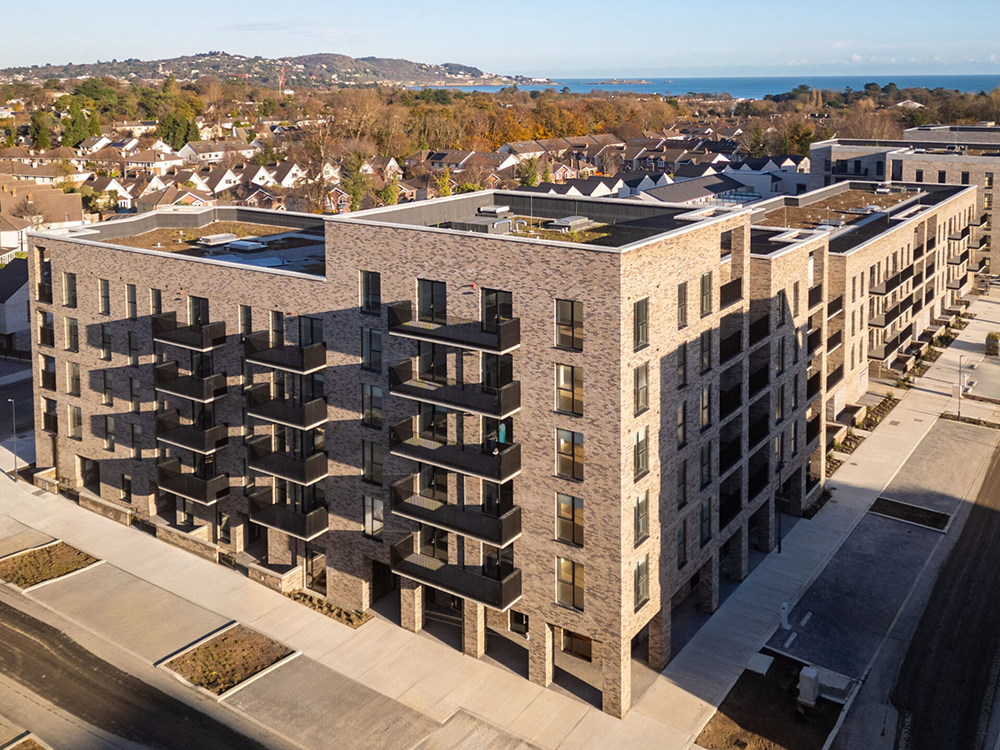
Ireland’s housing system is ambitious. The issue it faces is how to deliver at volume without compromising comfort, health or cost certainty. Over the last few years, the focus has shifted from promising performance to proving it. Passivhaus, Passive House Planning Package (PHPP), and post-occupancy evaluation are giving developers, local authorities, and residents the outcomes that matter day to day.
Mosart has worked in high performance buildings for more than three decades, from delivering the first certified Passive House in the English-speaking world in 2004 to large multi-unit schemes today. What they have learned through these projects and experiences is that scaling performance is not about flagship projects. It is about method and repeatability. The Irish playbook below shares some of what Mosart has learned through its decades of using Passivhaus principles and how to make it part of business as usual.
Start with PHPP as the source of truth
Set energy and comfort targets at concept stage and model the building before massing, façade and MEP decisions are fixed. This aligns design choices with measurable outcomes. Windows become energy-balancing devices, junctions are resolved to remove thermal bridges, and summer comfort is designed in through shading and form factor. When PHPP leads early, value engineering becomes value alignment rather than a slow erosion of performance.
Standardise details, not thinking
Every site is different, but junctions do not need to be reinvented. A tested library of thermal-bridge-free details, airtightness strategies, and ventilation layouts saves weeks of coordination, reduces change on site and gives contractors a clear target. Teams can still respond to context while drawing from verified solutions that have already delivered.

Build an airtightness culture on site
Airtightness is a behaviour as much as a specification. The best teams make the air barrier visible and owned.
They plan sequential blower-door tests, walk the line together and treat each leakage as a prompt to improve. The result goes beyond a number on a certificate. It gives quieter homes, stable temperatures and ventilation that performs as designed.
Commission ventilation as a health intervention
MVHR quality is central to comfort and indoor air quality. Proper commissioning verifies balanced flows, quiet operation and correct filtration. Clear resident handover reduces misuse and call-outs. When tenants understand their system, satisfaction rises and mould risk drops.
Close the loop with light-touch Post-Occupancy Evaluation (POE)
Scaling performance needs scalable feedback. Discreet portfolio-level monitoring of temperature, humidity, CO₂, and key energy circuits provides timely signals without drowning teams in data. Simple dashboards help housing providers spot overheating risks, ventilation issues or damp risk before they become failures. The goal is not big data. The goal is actionable signals that keep homes healthy and costs predictable.
Procure outcomes, not items
Performance-based briefs and contracts align incentives. Specify the indoor environmental quality you expect, the energy demand you will not exceed and the verification you require at each stage. Tie payment milestones to tests that matter, such as interim airtightness or ventilation commissioning. When outcomes are clearly defined, the delivery team focuses on what is proven to work.
Upskill the whole chain, not just the designers
Competence must run from concept to occupation. That means CPHD for designers, trades training for site teams, toolbox talks at critical junctions, and a resident-friendly handover. Mosart has trained more than 2,500 professionals internationally and we have learned that aligned understanding removes friction across the programme.
Mosart now offers a CPHD On-Demand course that professionals can complete flexibly online in their own time, covering the full Passivhaus design toolkit, from principles and PHPP to ventilation, thermal bridging and quality assurance. It meets a clear market need for flexibility while keeping the technical rigour clients and certifiers expect. For organisations building capacity at scale, it allows staff to train without disrupting live projects.

What Scotland can apply now
Adopt PHPP-first briefs for major schemes and social housing so the energy model leads from concept. Mandate sequential airtightness testing with clear acceptance criteria. Put MVHR commissioning on the critical path and document resident handover. Deploy representative POE on a sample of homes, then scale once the workflow is proven. Invest in targeted training across the chain, including flexible online options, so quality does not depend on a few champions.
This approach is already changing the conversation in Ireland. Once a client completes one high-performance project and captures the lessons, the next one is faster and the third becomes routine. Details are reused, supply chains are ready, and cost and programme risk come down. Most importantly, residents feel the difference. Homes are warm and quiet, air is fresh, and bills are predictable. That is the promise of Passivhaus when it is treated as a performance system rather than a badge.
Mosart designs and certifies to the Passivhaus standard, trains the people who deliver, and backs it up with data in use. It is a practical, evidence-led path that Scotland can scale on its own terms. Performance, not promises, and buildings that nurture people and the planet.
Written by Denis Manzke, Associate Director at Mosart.