
Centre for Net Zero High Density Buildings - expanding reach and impact
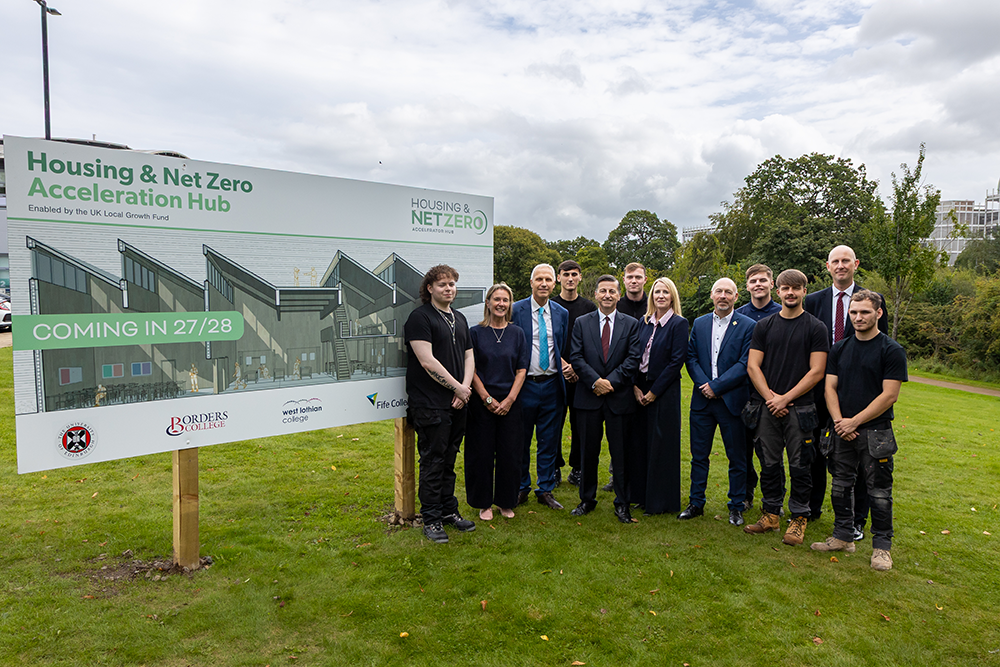
Secretary of State for Scotland Douglas Alexander MP launching the Housing and Net Zero Accelerator Hub investment (HaNZAH). (Image source: Scotland Office)
In 2024 the Centre for Net Zero High Density Buildings (CeNZ-HighDB) was founded thanks to funding from UKRI towards Green Economy Centres, as part of the UK’s Building a Greener Future. The Centre is led by the University of Edinburgh and partners with the Universities of Glasgow, Edinburgh Napier, Strathclyde, West of Scotland and over 128 industry and public sector partners across multiple projects and working groups.
The engagement and impact is led by BE-ST who also manage the ‘Retrofit Scotland’ web portal. The Centre was fully operational by March 2025, and formally launched in May 2025. It was heavily oversubscribed for the launch due to the scale of interest across multiple stakeholders. By October 2025, CeNZ-HighDB was already undertaking over 30 R&D projects with industry and public sector, six months ahead of schedule. Now in September 2026, the centre has awarded over 50 projects across a range of challenges for net zero for the built environment with 20 projects completed.
18 months of operation
50 projects funded
20 projects completed
Over £30 million investment into Scotland’s built environment sector
High density buildings, such as flats, are often home to the lowest income households and very often key workers. As such there is an urgency to ensure that future solutions lower carbon emissions and deliver healthy and warm homes, but also do not increase fuel poverty. Whilst previously the push for net zero and low carbon solutions has more often focused on houses, few largescale projects have attempted to tackle the combined approach involving high density buildings and associated infrastructure. This includes high density living such as blocks of flats or apartments, high density streetscapes with diverse archetypes of buildings, public and commercial buildings in close proximity and associated high voltage substations and large scale heating systems. Importantly through this combined approach there is an opportunity to also address key parameters including future scalability, place-based solutions, utilise economies of scale and deliver warm, comfortable and a legacy of healthy buildings.
Buildings within city and town environments involve an array of diverse construction material archetypes, high density streetscapes and restricted space for adapting infrastructure. The UK’s cities and towns also range from modern constructions to historic listed status buildings, meaning the complexity of solutions and where the merits of one approach can clash with those required on adjacent buildings and streetscapes.
High Density Living
Glasgow and Edinburgh [1]have the highest proportion of flats / apartments in the UK at 73% and 68% respectively. London has 54% and Scotland has 39%: far higher than the UK’s 20%.
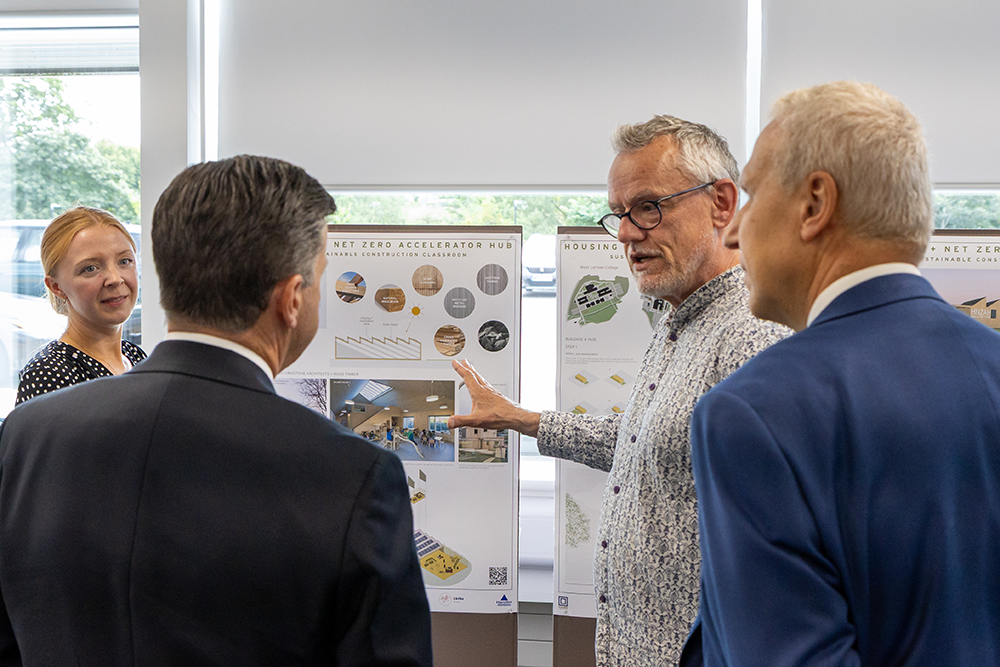
Malcolm Fraser of Fraser/Livingstone Architects outlining their designs and functions of the HaNZAH. (Image source: Scotland Office)
High density living often has limitations on extensions, adaptability, and additional space for water systems and services (pipework) required for some of the net zero solutions. There is further complexity in the diversity of occupancy types (owned, rented etc.) which may limit some solutions for apartment blocks and the lack of legal frameworks.
Addressing high density buildings in cities and towns requires a multi-faceted approach but also provides opportunities for cross-cutting themes and inter-disciplinary approaches. The Centre has six primary themes which are interlinked to assess, pilot and develop solutions.
Future Skills Facilities for Housing and Net Zero
A key component of the Centre is working with and supporting partnership approaches. A key example of this approach has been in developing and supporting the recent £25 Million investment by UK Government (Local Growth Fund) towards Housing and Net Zero Accelerator Skills Training Hubs (HaNZAH) for south east Scotland. Partnering across the region’s six local authorities and with West Lothian College, Edinburgh College, Borders College and Fife College with support from the City Region HCI Skills Gateway, has helped underpin the data and analysis to meet the future targets of training over 16,000 people during the next 10-12 years of operations.
Looking Ahead
As the Centre galvanises the various individual projects it is clear there will be cross-synergies in future impacts and outcomes. With less than 20 years to deliver net zero targets there is much for the entire built environment sector to undertake and deliver. However, there is no shortage of energy and determination from all of the partners the Centre works with to reach such an impact.
For further information and news updates on the Centre, please visit the website.