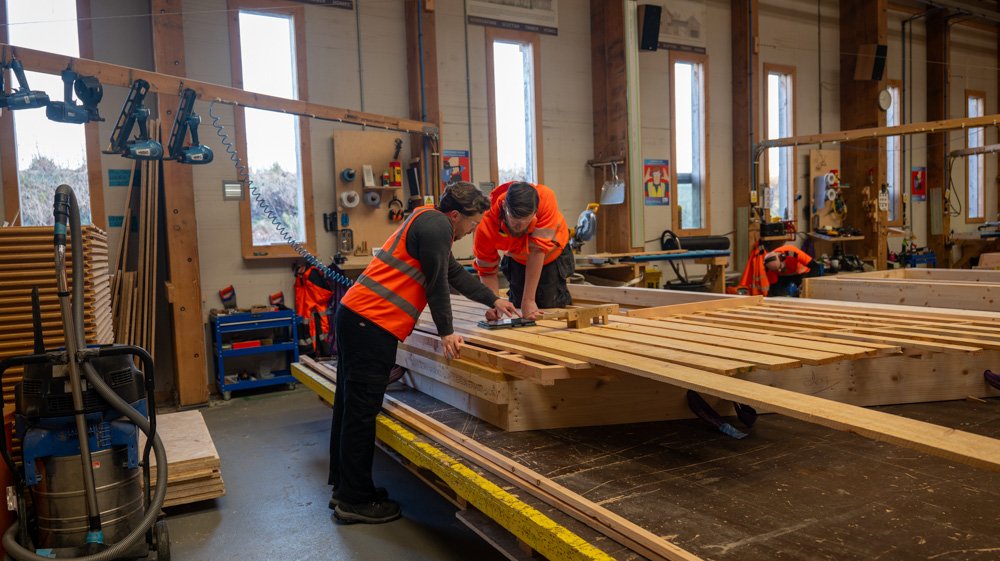
Built in a week: How MAKAR is rethinking the speed and substance of affordable housing
We are in the midst of joint climate and housing emergencies that demand not just more homes, but better quality and lower carbon homes, delivered at speed. MAKAR presents a solution that sits much earlier in the process than planning and policy, focusing on building design, material choice and off-site construction.
There is an often-repeated assumption that construction is inherently bad for the environment, and in many respects this is true. In Europe, 40% of global warming potential emissions are generated directly or indirectly by the built environment.
Combined with a desperate national shortage of housing, you would be forgiven for thinking that the need for houses to be delivered at speed will necessarily negatively impact our environment and climate.
Late last year, MAKAR set out to prove that affordable and low carbon homes can be manufactured and assembled at speed, without compromising on warmth, health, or longevity. Where traditional new-build construction times in the UK run to seven or ten months, MAKAR’s prototype family home was manufactured in just one week, and assembled in another.
By 10 AM on the first morning of assembly, two hours after the crane lifted the first panel, every wall panel was slotted into place. By the following afternoon, the roof and attic panels were in position, and the crane had left site. By the end of the week, the home was assembled to pre-fit-out stage (Wind and Watertight), including windows, doors, roof coverings and solar PV installation.
Speed was never the only goal. This approach raises the question: how can we utilise the dire need for new homes across the country while making a tangible contribution to climate action and better supporting those most in need, and thriving local economies.
MAKAR’s approach eschews high-carbon and petro-based materials, building from only natural materials and prioritising local Scottish timber in panel construction. Warmcel cellulose insulation is derived from recycled newspaper, and the home’s untreated larch cladding was sourced from a woodland approximately 70 metres from the assembly site, milled at Logie Timber around 30 miles away.
A University of East Anglia embodied carbon study of two earlier MAKAR affordable homes found the buildings store more carbon than was released in their manufacture and erection, making them carbon negative on delivery (to Wind and Watertight), a marked contrast with the long supply chains and high embodied and operational carbon typical of conventional construction.
Scotland's housing stock needs to perform better for its occupants. Highland Council's own figures show a 38% rise in mould and damp complaints between 2023/24 and 2024/25, even as repair numbers fall, a problem replicated across the UK's ageing and poorly insulated affordable homes. MAKAR homes are assembled from panels with layers of hygroscopic and vapour permeable natural materials allowing these ‘breathing walls’ to actively manage moisture and eliminating the health risk of damp and mould forming.
All of this can be achieved at scale and, with modelled heating costs of under £6 a week, can help protect those in Scotland and across the UK who are most vulnerable to mould, fuel poverty and price hikes.