
Guy Martin's Ice Box Challenge
TV presenter Guy Martin undertook a range of building physics experiments for his recent House Without Bills programme for Channel 4. As part of this, he conducted an 'Ice Box challenge' to see how well Passivhaus buildings perform in the summer months. The video of the experiment is now available to view on YouTube.
The Ice Box experiment involved two sheds, one constructed to the Passivhaus standard and one corresponding to the current building regulation standard. The well-travelled ice boxes originated in Glasgow, are currently used at NMITE (The New Model Institute for Technology and Engineering) in Hereford to help on-going training, and were briefly relocated to Guy's Lincolnshire home for the experiment. The sheds were each filled with 0.5 tons of ice and left for a week during Augiust 2025. Guy opened up the boxes after a week to see how much ice remained in each. The Passivhaus shed was found to have lost 30% of its ice, with an inside temperature of 5 degrees C, while the building regulation shed had lost 60% of its ice and had an internal temperature of 11 degrees C. Collaboration for success
Collaboration is critical to achieve impact, and at the event, two new strategic partnerships were announced.
One partnership – between Architecture and Design Scotland and BE-ST, Scotland's national innovation centre for construction and the built environment – will see the organisations work closely together to align the design and innovation in the built environment.
“This was an experiment to see - are we all going to melt in well-insulated houses? Insulation works in both directions, it takes longer for the heat energy from the sun outside to penetrate all of this insulation to get to the ice. So, will a well-insulated house cook you in the summer? No it won’t, it’ll keep you cooler.”
“The experiment demonstrated that the Passivhaus shed is good at keeping warmth in a building in the winter months and keeping things cool in the summer months, in much the way a thermos flask works. The ice boxes are a great visual way to help dispel the myth that Passivhaus buildings lead to overheating. The extra insulation and airtightness actually helped reduce the ice melting in the Passivhaus shed. the first all-electric phase of Agar Grove and we have been able to deliver these Passivhaus buildings using products and technologies that are common to buildings of this typology in the UK – demonstrating that low-energy Passivhaus projects aren’t at odds with mainstream construction.”
“The ice boxes, filmed as part of Guy Martin’s House Without Bills programme, highlight the role of practical demonstration in communicating the benefits of high-performance construction to a wider audience. They show how NMITE and the Centre for Advanced Timber Technology work with partners to bring building performance to life. Together, we’re making high-performance construction more visible, understandable and achievable.”
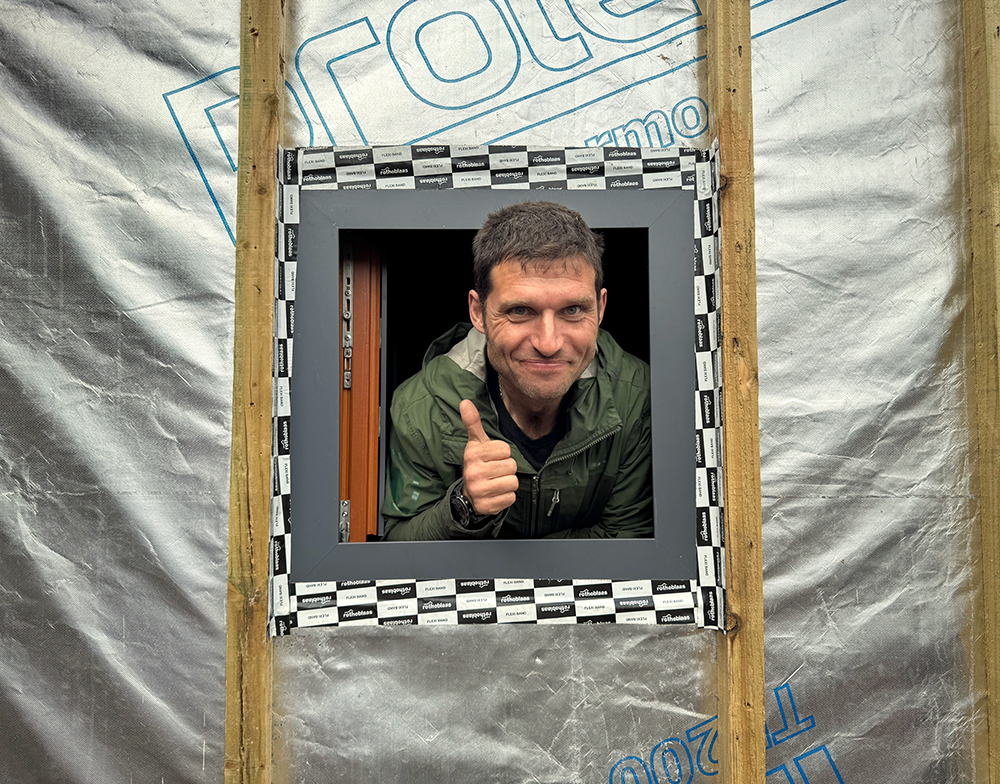
The ice box experiment was made possible thanks to a collaboration between the Passivhaus Trust The New Model Institute for Technology and Engineering and Edinburgh Napier University with support from the UK Research and Innovation funded Centre for Net Zero High Density Buildings, Scotland Beyond Net Zero and Housing Construction and Infrastructure Skills Gateway — The Edinburgh and South East Scotland City Region Deal. The Ice-Boxes were originally constructed by Built Environment – Smarter Transformation. Help with preparation of the ice boxes was also gratefully received from Passivhaus Trust member Herefordshire-based Mike Whitfield Construction.
The ice boxes used in the experiment form part of NMITE’s applied teaching and industry engagement activity. They are used to support learning on building performance, construction quality and low-carbon design, helping students and industry professionals connect design intent with real-world outcomes.